
How to Combine Two Names Into One: 7 Practical Methods
Learn seven workable blending techniques, with examples and advice for choosing the most natural new name.
Combining two names is more than cutting each in half. A good blend usually has an identifiable piece of each name and a rhythm that sounds easy when spoken. Here are practical approaches to test before choosing your final idea.
1. Try the simplest combination first
Join both full names in either order. This is especially useful for social handles and project names where recognizability matters more than brevity. Alex + Jordan can become AlexJordan, but JordanAlex also has a different rhythm.
2. Blend the first sound with the second ending
Use the first one to three syllable-like groups of one name and the ending of the other. Write several versions rather than committing to an exact halfway cut. Some smooth blends happen when one name contributes far more letters than the other.
3. Reverse the order
People naturally prefer the name they entered first, but reversing the inputs can uncover better options. Compare the pairs aloud without looking at the original name order.
4. Find vowel connections
If the first part ends in a vowel and the next part begins with one, try collapsing the repeated vowel. If a combination creates a cluster of four consonants, move the joining point until it becomes pronounceable.
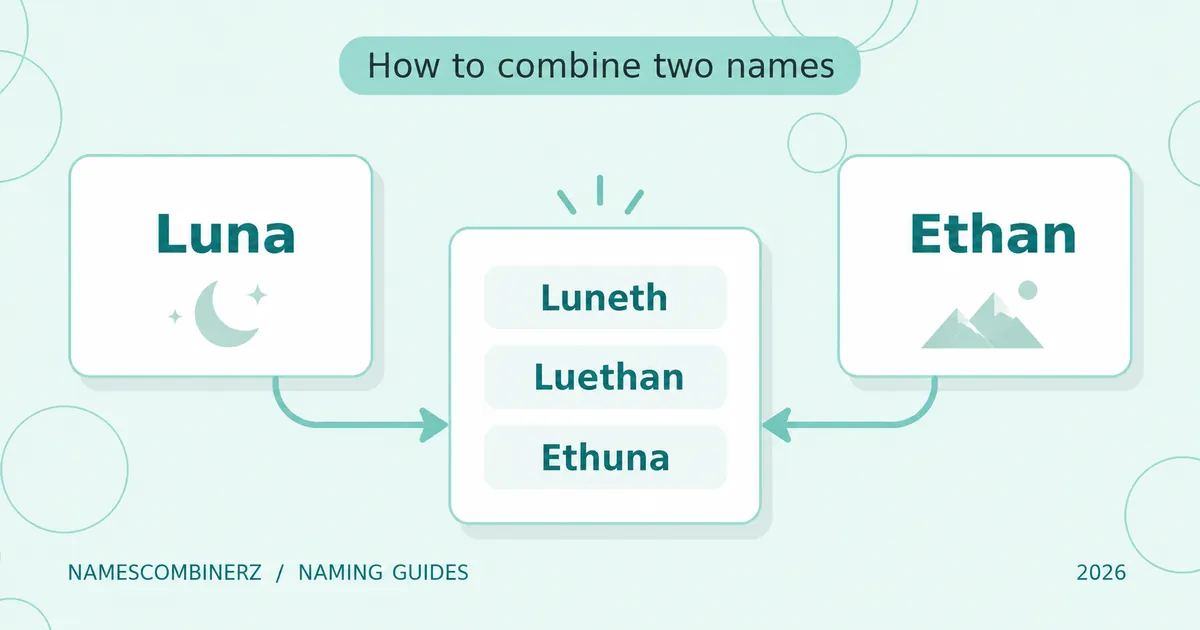
5. Keep a shared sound
When both names contain similar sounds, use that sound as a bridge instead of repeating it. The result may be shorter while still acknowledging both originals.
6. Say the result out loud
Read every promising candidate quickly three times. Ask whether a friend could spell it after hearing it just once. A memorable name is often clearer than the most unusual option.
7. Test the real-life use
For couples, it should fit in a caption; for a brand, it should survive a phone conversation; for a baby, it should work with the family name and local cultural conventions. A generator provides ideas, but context decides what makes a good name.
A short quality checklist
- Recognizable connection to both original names
- Pronounceable on the first attempt
- Easy to remember after a few minutes
- No unintended associations in relevant languages
- Appropriate for the specific person, account, or project
Try these steps directly in our Name Combiner and save the strongest candidates for comparison.
A practical deep dive with real-world checks
Use the following steps in order if you are starting from scratch, or jump to the part that addresses your biggest obstacle. The goal is to produce a small number of ideas that are understandable, appropriate and easy to test. For public or commercial naming, distinguish a creative shortlist from checked availability and formal rights.
1. Start with the sounds, not merely the letters
Read each source name aloud before moving a single character. The written spelling can hide the useful joining points, especially when a pair contains silent letters or consonants that are pronounced differently in different languages. Write down the sounds people emphasize naturally and protect whichever part is most recognizable.
The underlying decision is about human recognition, not the largest number of generated variations. Work from a blank sheet rather than from a hundred automatic suggestions. Put your first three possibilities on separate lines and annotate which part of the idea comes from which source.
Alex and Jordan might suggest Alexan or Jorlex as sketches, but a different pair may blend more naturally from the middle. None is automatically a registered name or a standard word.
Try it yourself: Say both names at conversational speed and underline the syllable you would not want to lose. Use the observation to decide whether to keep, revise or discard the candidate.
2. Create four simple splice patterns
Try the beginning of A with the end of B; the beginning of B with the end of A; a short initial from each; and one intact name followed by a short piece of the other. Comparing four deliberate shapes gives a more useful set than randomly joining letters until a candidate looks unusual.
A practical comparison helps distinguish your own familiarity from how the idea appears to a first-time reader. Try a blind read. Ask one person who has not seen your original inputs to describe what they notice first, then show them the construction.
For Mira and Adam, Miram is a possible written experiment. Adira is another kind of sketch, but any real-world meaning or existing-name association needs separate checking.
Try it yourself: Keep each pattern in a separate row so you can compare like with like. Use the observation to decide whether to keep, revise or discard the candidate.
3. Use vowels to soften difficult joins
Consonant clusters frequently reveal the exact place where two names were joined. Moving the cut a letter earlier or later often solves the problem. Sometimes dropping a repeated vowel helps; sometimes retaining one vowel makes the candidate easier to recognize. Judge the spoken name rather than mechanically requiring equal parts.
This is where a short written test can prevent enthusiastic but inconsistent choices. Make the comparison reproducible by recording the exact version you tested and the reason it made your shortlist. For instance, if you change a vowel, keep both spellings long enough to compare them aloud.
A candidate ending in three consonants followed by another three is likely to be harder to pronounce than a similar option with a clear vowel bridge.
Try it yourself: Read each candidate without looking at the input names, and mark the ones you can pronounce on the first try. Use the observation to decide whether to keep, revise or discard the candidate.
4. Test the reversed order fairly
The first name typed into a generator can bias the shortlist. When both people or concepts deserve equal prominence, run the reverse order and compare the results without remembering who supplied which first. A reverse arrangement can reveal a better rhythm, an accidental new word, or a confusing association.
Consider the environment in which someone will encounter the result without your explanation. Test the idea at realistic size and speed. A nickname in a text message, a business name on a receipt and a child's name spoken in a classroom place different demands on the same letters.
Two siblings combining Asha and Daniel might prefer an Asha-led version for sound, even if the original worksheet placed Daniel first.
Try it yourself: Use one consistent criterion for both orders: ease of speech, clarity and personal relevance. Use the observation to decide whether to keep, revise or discard the candidate.
5. Make room for short and long forms
A compact five-letter name can make an excellent online handle, while a longer name may better preserve family recognition. The correct length depends on where the blend will appear and who must use it. A length filter is an editing aid, not a measurement of quality.
Instead of asking for approval, look for an observable point of confusion or advantage. Look for disconfirming evidence, not just compliments. A shortlist becomes more trustworthy when you invite someone to identify confusing spelling, unintended resemblance or unfamiliar pronunciation.
A couple hashtag that can fit neatly on a small invitation may work poorly as a formal baby name, where long-term spelling matters more.
Try it yourself: Separate candidates into short, medium and long groups and compare them in the intended context. Use the observation to decide whether to keep, revise or discard the candidate.
6. Screen accidental meanings and associations
A newly invented spelling can still match an existing word, slang term, surname, trademark or expression elsewhere. Try searching the full candidate in quotation marks and asking fluent speakers of relevant languages how it reads. A pleasing sound is not proof of a harmless or unused name.
A sensible limit on brainstorming creates room to evaluate what you have already collected. Set the task a clear stopping point. Creative search can become endless because every candidate invites another variation.
A brand blending two founders’ surnames should be checked against business names and existing trademarks before printed packaging is ordered.
Try it yourself: Treat unfamiliar spellings as a prompt to investigate, not as evidence of originality. Use the observation to decide whether to keep, revise or discard the candidate.
7. Compare the names in real use
Say the blend as an introduction, put it in a sentence and imagine someone writing it from dictation. Printed initials, email addresses, spoken announcements and small profile labels expose problems that a large headline does not. The same candidate can be excellent for one purpose and unsuitable for another.
Some checks require information outside the generator and deserve their own place in the process. Keep an honest record of uncertainty. Some questions, particularly language meanings, trademark conflicts and account availability, cannot be settled by a blending algorithm.
A gamertag may tolerate a playful spelling. A baby’s name will be spoken by teachers, family members and colleagues for decades.
Try it yourself: Create two mock uses: one spoken aloud and one written at the actual size it will appear. Use the observation to decide whether to keep, revise or discard the candidate.
8. Choose with a weighted shortlist
Instead of choosing whatever looks brightest, rate the finalists for pronunciation, recognizability, memorable rhythm, relevance and unintended associations. Give greater weight to factors that matter for your intended use. Save the top three, leave the list overnight and test again without the original options visible.
The final goal is a usable idea, not proof that your creative method can always produce one. Finish by comparing a simple alternative. A creative transformation earns its place only when it works better for your purpose than leaving the words unchanged or choosing a familiar label.
For a brand, clearance and search ambiguity may dominate. For a private couple nickname, emotional fit may carry much more weight.
Try it yourself: Give each criterion a score from one to five and write a sentence explaining the lowest score. Use the observation to decide whether to keep, revise or discard the candidate.
A reusable worksheet for your next naming session
Copy the prompts below into a note before generating a new batch. A written record is especially useful when you are comparing choices with another person or revisiting the idea after a few days. It turns an exciting but subjective naming session into a process you can review.
- Start with the sounds, not merely the letters: Say both names at conversational speed and underline the syllable you would not want to lose. Record one candidate, one observation and one change you would consider. Do not award a high score merely because the idea is new. The important point is whether the observation helps with how to combine two names in your actual setting.
- Create four simple splice patterns: Keep each pattern in a separate row so you can compare like with like. Record one candidate, one observation and one change you would consider. Do not award a high score merely because the idea is new. The important point is whether the observation helps with how to combine two names in your actual setting.
- Use vowels to soften difficult joins: Read each candidate without looking at the input names, and mark the ones you can pronounce on the first try. Record one candidate, one observation and one change you would consider. Do not award a high score merely because the idea is new. The important point is whether the observation helps with how to combine two names in your actual setting.
- Test the reversed order fairly: Use one consistent criterion for both orders: ease of speech, clarity and personal relevance. Record one candidate, one observation and one change you would consider. Do not award a high score merely because the idea is new. The important point is whether the observation helps with how to combine two names in your actual setting.
- Make room for short and long forms: Separate candidates into short, medium and long groups and compare them in the intended context. Record one candidate, one observation and one change you would consider. Do not award a high score merely because the idea is new. The important point is whether the observation helps with how to combine two names in your actual setting.
- Screen accidental meanings and associations: Treat unfamiliar spellings as a prompt to investigate, not as evidence of originality. Record one candidate, one observation and one change you would consider. Do not award a high score merely because the idea is new. The important point is whether the observation helps with how to combine two names in your actual setting.
- Compare the names in real use: Create two mock uses: one spoken aloud and one written at the actual size it will appear. Record one candidate, one observation and one change you would consider. Do not award a high score merely because the idea is new. The important point is whether the observation helps with how to combine two names in your actual setting.
- Choose with a weighted shortlist: Give each criterion a score from one to five and write a sentence explaining the lowest score. Record one candidate, one observation and one change you would consider. Do not award a high score merely because the idea is new. The important point is whether the observation helps with how to combine two names in your actual setting.
Once you have filled in the worksheet, compare the first draft with the version you would really be comfortable using. If the strongest candidate survives the tests, save it alongside the reason for choosing it. If the choice still feels uncertain, a small amount of focused testing is more useful than starting an enormous new list.
Frequently asked questions
Is a name blend the same as an anagram?
No. A blend usually takes recognizable portions of the source names, while an anagram rearranges the letters of a chosen word or phrase. Those methods produce very different styles of candidates.
Should a combined name contain half of each original?
Not necessarily. A smooth sound often requires unequal contributions. Fairness can mean that both people recognize their name in the result, not that the character counts match.
Can I use a combined name for a business?
You can explore names with a generator, but you should check existing businesses, trademarks, relevant domains and other rights before using any candidate commercially.
How many candidates should I keep?
Start broad, then reduce the list to three to five. A short, well-reviewed shortlist is easier to test and discuss than hundreds of slight spelling variations.
What is the fastest way to test this idea?
For how to combine two names, start with start with the sounds, not merely the letters. Make a shortlist of three rather than a huge collection, then perform the specific test from the relevant section. Try it in a real sentence, a practical mockup or a neutral conversation. A small test tied to the intended audience is more revealing than a quick popularity poll.
How do I know whether a suggestion is actually useful?
For how to combine two names, start with create four simple splice patterns. A useful candidate should work for the stated purpose and survive the practical check that matters most: clarity, pronunciation, cultural fit or potential conflict. Write one reason it succeeds and one uncertainty to resolve. The result should still make sense after the exciting first impression fades.
Next steps: turn this research into a shortlist
Open our Name Combiner to explore concrete variations. Generate broadly, save selectively and revisit the strongest choices after testing. For a different approach, compare the related Couple Name Combiner and Baby Name Combiner tools. These links are exercises, not claims that every output is available or suitable.
Editorial note: This guide provides creative methods and practical checks; it does not certify origin, meaning, legal rights, platform availability or suitability for every culture. Review the results independently before making a permanent decision.
Turn what you learned into ideas.
Make a shortlist with our free name generator.