
A Practical Checklist for Choosing a Brand Name
Evaluate a potential brand name for clarity, fit, uniqueness and real-world use.
Brand naming mixes creative thinking with practical checks. A catchy result is only a candidate until it has been checked against competitors, domain availability and relevant trademark rights.
Choose the idea you want to signal
Decide whether the business name should emphasize speed, craftsmanship, trust, creativity or a location. This reduces random results and helps make the eventual name feel consistent with your product.
Use the say-and-spell test
Ask someone unfamiliar with the brand to spell the name after hearing it once. If they cannot, you may still choose it, but account for the extra work in marketing and word-of-mouth referrals.
Search before you register
Check relevant business registries, trademark databases, app stores, domains and social handles. An apparently unique generated blend may conflict with an existing commercial name.
Design a simple visual identity
Test the word as plain text before investing in a logo. Does it work in small letters, in all caps, and on a mobile screen? Names dependent on unusual symbols can be difficult to use.
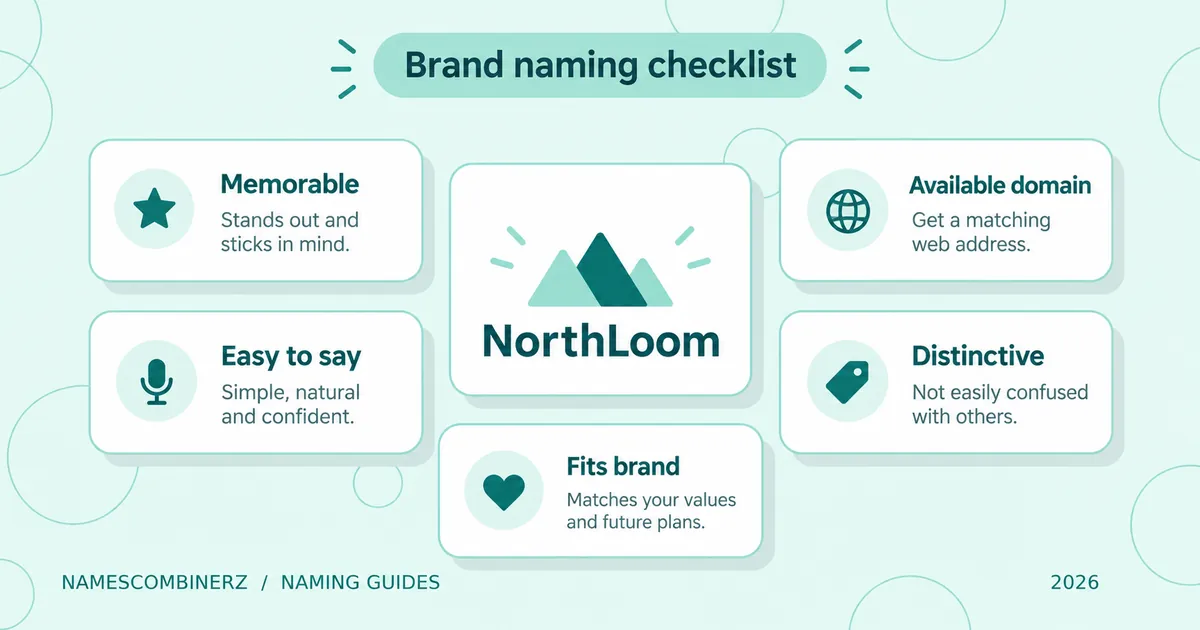
Invite feedback from target customers
Ask a few people to describe what the name suggests, without giving them the answer first. Compare those impressions to your intended business positioning.
Brainstorm with the Brand Name Generator and save your shortlist to discuss with collaborators.
A practical deep dive with real-world checks
Use the following steps in order if you are starting from scratch, or jump to the part that addresses your biggest obstacle. The goal is to produce a small number of ideas that are understandable, appropriate and easy to test. For public or commercial naming, distinguish a creative shortlist from checked availability and formal rights.
1. Write the positioning before naming
Define who the business serves, what changes for customers and how you want it to feel. A name that fits a calm repair service may not suit an energetic gaming brand. Without positioning, random combinations tend to sound interchangeable.
The underlying decision is about human recognition, not the largest number of generated variations. Work from a blank sheet rather than from a hundred automatic suggestions. Put your first three possibilities on separate lines and annotate which part of the idea comes from which source.
A studio focused on sustainable textiles might explore words about craft, texture and careful making rather than broad technology terms.
Try it yourself: Write a single sentence with your customer, offer and intended tone. Use the observation to decide whether to keep, revise or discard the candidate.
2. Generate several naming territories
Create distinct directions such as descriptive names, suggestive names, invented blends, founder names and evocative metaphors. A territory prevents the process from becoming a contest between nearly identical variations of one favorite.
A practical comparison helps distinguish your own familiarity from how the idea appears to a first-time reader. Try a blind read. Ask one person who has not seen your original inputs to describe what they notice first, then show them the construction.
NorthLoom could suggest craft and direction, but its suitability would depend on the actual company and clearance checks.
Try it yourself: Make at least three lists of different naming approaches before scoring candidates. Use the observation to decide whether to keep, revise or discard the candidate.
3. Check spoken and visual clarity
Say the name in a normal conversation, in a noisy room and alongside a website address. Then reduce it to a tiny mobile screen label. Names that need repeated spelling corrections or tiny decorative details may create friction.
This is where a short written test can prevent enthusiastic but inconsistent choices. Make the comparison reproducible by recording the exact version you tested and the reason it made your shortlist. For instance, if you change a vowel, keep both spellings long enough to compare them aloud.
A product name could look elegant in a huge wordmark and still become unreadable in a browser tab or an invoice.
Try it yourself: Run a phone test and a small-size mockup with no explanation provided. Use the observation to decide whether to keep, revise or discard the candidate.
4. Think beyond the first product
A product-specific phrase can box a business into a niche that may change. A very abstract name can be hard to explain. Consider how far you expect the offer to expand over the next few years without assuming you know the future.
Consider the environment in which someone will encounter the result without your explanation. Test the idea at realistic size and speed. A nickname in a text message, a business name on a receipt and a child's name spoken in a classroom place different demands on the same letters.
A company initially selling notebooks might later add stationery and workshops; a name tied only to lined paper could feel restrictive.
Try it yourself: List three reasonable adjacent services and ask whether the name still makes sense. Use the observation to decide whether to keep, revise or discard the candidate.
5. Research existing uses and marks
Search the exact spelling, near spellings, industry directories and official trademark databases in places where you plan to trade. Similarity of sound and category can matter, not only exact matches. No free name generator can guarantee rights or legal safety.
Instead of asking for approval, look for an observable point of confusion or advantage. Look for disconfirming evidence, not just compliments. A shortlist becomes more trustworthy when you invite someone to identify confusing spelling, unintended resemblance or unfamiliar pronunciation.
Buying a domain is not proof that the business name is clear of conflicts, and a social handle being unused proves even less.
Try it yourself: Record the databases searched, location, category and date; seek legal advice for meaningful launch decisions. Use the observation to decide whether to keep, revise or discard the candidate.
6. Consider domain and social practicality
A brand does not always need a perfect exact-match domain, but customers should not be misdirected to another business. Avoid domain hacks or subtle spellings that demand explanations in audio advertising.
A sensible limit on brainstorming creates room to evaluate what you have already collected. Set the task a clear stopping point. Creative search can become endless because every candidate invites another variation.
A brand may prefer a slightly longer, clear domain rather than a short, confusing variation of another organization.
Try it yourself: Speak the proposed URL aloud and ask a friend where they would naturally type it. Use the observation to decide whether to keep, revise or discard the candidate.
7. Test the name with target customers
Ask people in your likely audience what they think the company does, how the name feels and whether they can recall it after a short pause. Do not ask only whether they like it, as politeness produces little useful evidence.
Some checks require information outside the generator and deserve their own place in the process. Keep an honest record of uncertainty. Some questions, particularly language meanings, trademark conflicts and account availability, cannot be settled by a blending algorithm.
Five relevant reactions with reasons often teach more than dozens of yes/no votes from unrelated friends.
Try it yourself: Keep the question neutral and record first impressions before showing the brand concept. Use the observation to decide whether to keep, revise or discard the candidate.
8. Document the final decision
Record why the name was chosen, rejected alternatives, clearance work and intended spelling. This avoids endless reopening of earlier debates and gives collaborators a shared understanding of brand tone and usage.
The final goal is a usable idea, not proof that your creative method can always produce one. Finish by comparing a simple alternative. A creative transformation earns its place only when it works better for your purpose than leaving the words unchanged or choosing a familiar label.
A short brand memo can include pronunciation, logo restrictions, capitalization, domain decisions and pending trademark work.
Try it yourself: Archive your shortlist and update it if the business direction changes. Use the observation to decide whether to keep, revise or discard the candidate.
A reusable worksheet for your next naming session
Copy the prompts below into a note before generating a new batch. A written record is especially useful when you are comparing choices with another person or revisiting the idea after a few days. It turns an exciting but subjective naming session into a process you can review.
- Write the positioning before naming: Write a single sentence with your customer, offer and intended tone. Record one candidate, one observation and one change you would consider. Do not award a high score merely because the idea is new. The important point is whether the observation helps with brand naming checklist in your actual setting.
- Generate several naming territories: Make at least three lists of different naming approaches before scoring candidates. Record one candidate, one observation and one change you would consider. Do not award a high score merely because the idea is new. The important point is whether the observation helps with brand naming checklist in your actual setting.
- Check spoken and visual clarity: Run a phone test and a small-size mockup with no explanation provided. Record one candidate, one observation and one change you would consider. Do not award a high score merely because the idea is new. The important point is whether the observation helps with brand naming checklist in your actual setting.
- Think beyond the first product: List three reasonable adjacent services and ask whether the name still makes sense. Record one candidate, one observation and one change you would consider. Do not award a high score merely because the idea is new. The important point is whether the observation helps with brand naming checklist in your actual setting.
- Research existing uses and marks: Record the databases searched, location, category and date; seek legal advice for meaningful launch decisions. Record one candidate, one observation and one change you would consider. Do not award a high score merely because the idea is new. The important point is whether the observation helps with brand naming checklist in your actual setting.
- Consider domain and social practicality: Speak the proposed URL aloud and ask a friend where they would naturally type it. Record one candidate, one observation and one change you would consider. Do not award a high score merely because the idea is new. The important point is whether the observation helps with brand naming checklist in your actual setting.
- Test the name with target customers: Keep the question neutral and record first impressions before showing the brand concept. Record one candidate, one observation and one change you would consider. Do not award a high score merely because the idea is new. The important point is whether the observation helps with brand naming checklist in your actual setting.
- Document the final decision: Archive your shortlist and update it if the business direction changes. Record one candidate, one observation and one change you would consider. Do not award a high score merely because the idea is new. The important point is whether the observation helps with brand naming checklist in your actual setting.
Once you have filled in the worksheet, compare the first draft with the version you would really be comfortable using. If the strongest candidate survives the tests, save it alongside the reason for choosing it. If the choice still feels uncertain, a small amount of focused testing is more useful than starting an enormous new list.
Frequently asked questions
Does a business name generator check trademarks?
No. It produces ideas, not a clearance opinion. Search official databases and consider professional advice before a commercial launch.
Should I choose a short or descriptive brand name?
Choose based on the audience and product. Short names can be memorable; descriptive ones can explain the offer faster.
Can I use an invented word?
Often yes, but the new word may already appear as a company, domain, surname or slang expression somewhere else.
Is the matching .com essential?
Not universally. A clear, appropriate domain matters; the right choice depends on audience, market and confusion risks.
What is the fastest way to test this idea?
For brand naming checklist, start with write the positioning before naming. Make a shortlist of three rather than a huge collection, then perform the specific test from the relevant section. Try it in a real sentence, a practical mockup or a neutral conversation. A small test tied to the intended audience is more revealing than a quick popularity poll.
How do I know whether a suggestion is actually useful?
For brand naming checklist, start with generate several naming territories. A useful candidate should work for the stated purpose and survive the practical check that matters most: clarity, pronunciation, cultural fit or potential conflict. Write one reason it succeeds and one uncertainty to resolve. The result should still make sense after the exciting first impression fades.
Next steps: turn this research into a shortlist
Open our Brand Name Generator to explore concrete variations. Generate broadly, save selectively and revisit the strongest choices after testing. For a different approach, compare the related Name Combiner and Blog Name Generator tools. These links are exercises, not claims that every output is available or suitable.
Editorial note: This guide provides creative methods and practical checks; it does not certify origin, meaning, legal rights, platform availability or suitability for every culture. Review the results independently before making a permanent decision.
Turn what you learned into ideas.
Make a shortlist with our free name generator.