
How to Create Baby Name Ideas From Parents’ Names
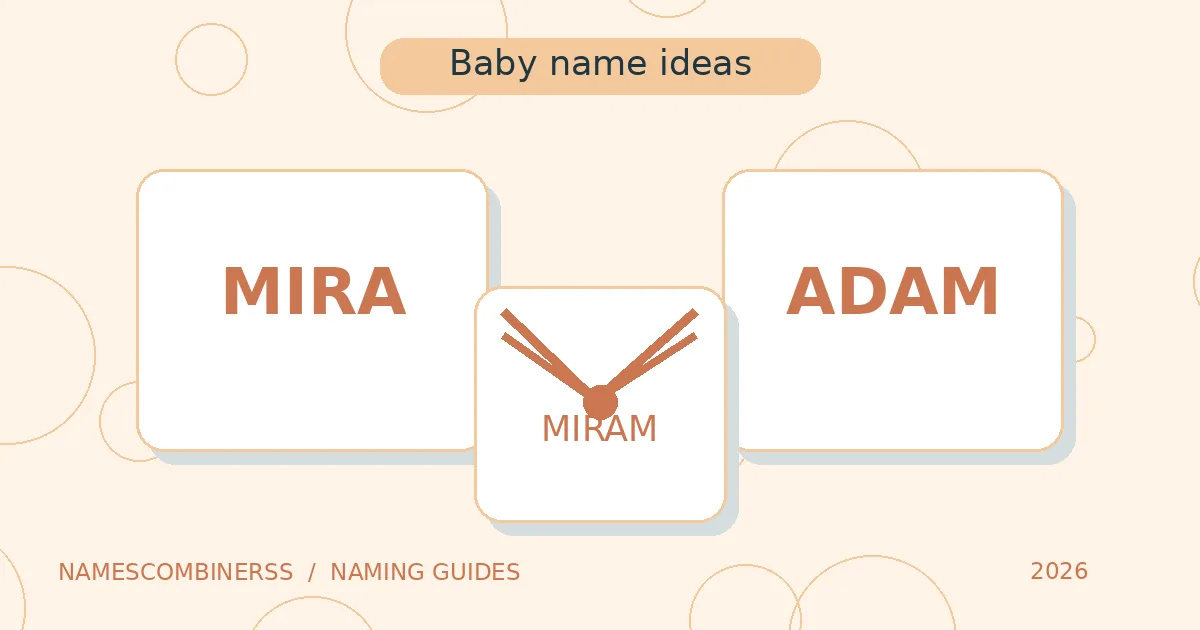
A thoughtful guide to blending two family names without sacrificing pronunciation or meaning.
Blending parents’ names is one way to honor both sides of a family. It can also lead to unfamiliar spellings and accidental meanings, so treat generated options as the start of a conversation rather than a list of vetted given names.
Choose which parts are meaningful
Decide whether you want a first-syllable echo, a distinctive ending, or letters from both names. You do not need to preserve equal numbers of letters for the name to feel connected to both parents.
Prioritize everyday usability
Try saying the candidate with the family surname, saying it at normal speed, and asking someone to spell it back. A result that looks attractive in writing may sound awkward or create initials you did not intend.
Research meaning and culture
A newly blended name might already exist in another language. Before selecting an official name, check its meaning, likely pronunciation, legal spelling rules, and cultural fit. If multiple scripts matter to your family, look at how the name will be written and spoken in each.
Use sound filters carefully
Soft-sounding vowel endings and stronger consonant endings are stylistic descriptions, not rules about which names belong to girls or boys. You can select the sound you prefer regardless of gender.
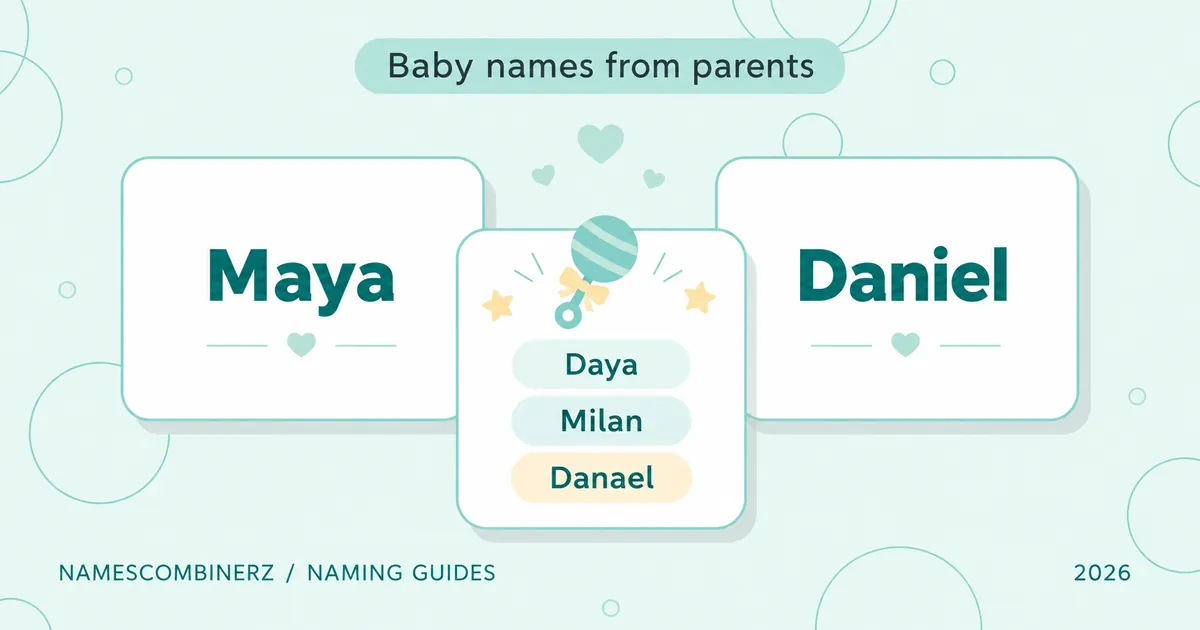
Try the Baby Name Combiner to explore possibilities, and use its length filter to compare options that suit your family surname.
A practical deep dive with real-world checks
Use the following steps in order if you are starting from scratch, or jump to the part that addresses your biggest obstacle. The goal is to produce a small number of ideas that are understandable, appropriate and easy to test. For public or commercial naming, distinguish a creative shortlist from checked availability and formal rights.
1. List the sounds that matter to your family
Write each parent’s name, nickname and commonly used pronunciation. Some families want an equal blend; others want a subtle reference to a grandparent or a shared letter pattern. A clear goal helps prevent hundreds of arbitrary spellings.
The underlying decision is about human recognition, not the largest number of generated variations. Work from a blank sheet rather than from a hundred automatic suggestions. Put your first three possibilities on separate lines and annotate which part of the idea comes from which source.
Mira and Adam can inspire Miram as a hypothetical combination, though that does not establish the name’s cultural origin or meaning.
Try it yourself: Ask each parent to highlight one sound, not merely a letter, that they would like represented. Use the observation to decide whether to keep, revise or discard the candidate.
2. Use initial-and-ending combinations
Begin with simple joins before trying elaborate rearrangements. Two- or three-letter beginnings can fit with a final syllable if the vowels align. Test both orders, and be willing to discard combinations that require long explanations.
A practical comparison helps distinguish your own familiarity from how the idea appears to a first-time reader. Try a blind read. Ask one person who has not seen your original inputs to describe what they notice first, then show them the construction.
The sound of the last syllable matters more than whether the new written form uses exactly the same number of letters from each original name.
Try it yourself: Try a table with A-start/B-end, B-start/A-end, shared middle and untouched family inspiration. Use the observation to decide whether to keep, revise or discard the candidate.
3. Understand that sound is not meaning
A new spelling may resemble a familiar name, but etymology cannot be deduced from resemblance. Check reliable linguistic and cultural references for an existing name, and distinguish a newly coined family creation from an established word.
This is where a short written test can prevent enthusiastic but inconsistent choices. Make the comparison reproducible by recording the exact version you tested and the reason it made your shortlist. For instance, if you change a vowel, keep both spellings long enough to compare them aloud.
A combination can be meaningful to a family because of who inspired it while having no independently established dictionary meaning.
Try it yourself: Record the family story separately from any claimed language origin. Use the observation to decide whether to keep, revise or discard the candidate.
4. Check pronunciation across languages
Consider how grandparents, classmates and future colleagues might say the name. Some letter combinations have very different sounds in Urdu, English, Arabic and other languages. A transliteration needs testing with people who actually use each language.
Consider the environment in which someone will encounter the result without your explanation. Test the idea at realistic size and speed. A nickname in a text message, a business name on a receipt and a child's name spoken in a classroom place different demands on the same letters.
A spelling that seems obvious to one parent may be pronounced differently by another relative, even when both speakers are careful.
Try it yourself: Write a simple phonetic note and ask people to pronounce the name without seeing your note first. Use the observation to decide whether to keep, revise or discard the candidate.
5. Hear the full name together
Try each candidate with the family name and any intended middle name. Look for awkward rhythm, unintended initials and repeated syllables. A sound that works in isolation can become difficult when followed by a particular surname.
Instead of asking for approval, look for an observable point of confusion or advantage. Look for disconfirming evidence, not just compliments. A shortlist becomes more trustworthy when you invite someone to identify confusing spelling, unintended resemblance or unfamiliar pronunciation.
For a long family surname, a shorter given name may feel balanced, but that preference is personal rather than a universal rule.
Try it yourself: Say the full name in ordinary introductions and imagine hearing it called at school. Use the observation to decide whether to keep, revise or discard the candidate.
6. Explore gender style without stereotypes
A tool may offer girl, boy and any options for navigation, but names are shaped by culture and individual preference. Do not treat an algorithmic style label as a fixed rule about who may use a name.
A sensible limit on brainstorming creates room to evaluate what you have already collected. Set the task a clear stopping point. Creative search can become endless because every candidate invites another variation.
A family may prefer a flexible, unisex-sounding suggestion or one connected with a longstanding local naming tradition.
Try it yourself: Start with Any, then use narrower filters only if they actually serve your family’s preferences. Use the observation to decide whether to keep, revise or discard the candidate.
7. Check cultural and religious context
Some names carry established significance, and spelling changes can alter the familiar meaning or cause concern. Speak with trusted knowledgeable people where those traditions matter. A generator cannot verify whether a newly invented name is appropriate in every community.
Some checks require information outside the generator and deserve their own place in the process. Keep an honest record of uncertainty. Some questions, particularly language meanings, trademark conflicts and account availability, cannot be settled by a blending algorithm.
A parent might love a sound but decide against a blend after learning that it resembles an undesirable word in the family language.
Try it yourself: Treat community feedback as substantive information, not as a final popularity contest. Use the observation to decide whether to keep, revise or discard the candidate.
8. Shortlist for a lifetime
Imagine the name on a classroom register, application form and introduction decades from now. Children become independent adults, so a baby name should not depend solely on a short-lived trend or social hashtag.
The final goal is a usable idea, not proof that your creative method can always produce one. Finish by comparing a simple alternative. A creative transformation earns its place only when it works better for your purpose than leaving the words unchanged or choosing a familiar label.
A sweet-sounding novelty with a difficult spelling may create repeated corrections; a simpler blend may age more comfortably.
Try it yourself: Keep three options and evaluate each for sound, meaning, spelling, privacy and long-term practicality. Use the observation to decide whether to keep, revise or discard the candidate.
A reusable worksheet for your next naming session
Copy the prompts below into a note before generating a new batch. A written record is especially useful when you are comparing choices with another person or revisiting the idea after a few days. It turns an exciting but subjective naming session into a process you can review.
- List the sounds that matter to your family: Ask each parent to highlight one sound, not merely a letter, that they would like represented. Record one candidate, one observation and one change you would consider. Do not award a high score merely because the idea is new. The important point is whether the observation helps with baby names combining parents names in your actual setting.
- Use initial-and-ending combinations: Try a table with A-start/B-end, B-start/A-end, shared middle and untouched family inspiration. Record one candidate, one observation and one change you would consider. Do not award a high score merely because the idea is new. The important point is whether the observation helps with baby names combining parents names in your actual setting.
- Understand that sound is not meaning: Record the family story separately from any claimed language origin. Record one candidate, one observation and one change you would consider. Do not award a high score merely because the idea is new. The important point is whether the observation helps with baby names combining parents names in your actual setting.
- Check pronunciation across languages: Write a simple phonetic note and ask people to pronounce the name without seeing your note first. Record one candidate, one observation and one change you would consider. Do not award a high score merely because the idea is new. The important point is whether the observation helps with baby names combining parents names in your actual setting.
- Hear the full name together: Say the full name in ordinary introductions and imagine hearing it called at school. Record one candidate, one observation and one change you would consider. Do not award a high score merely because the idea is new. The important point is whether the observation helps with baby names combining parents names in your actual setting.
- Explore gender style without stereotypes: Start with Any, then use narrower filters only if they actually serve your family’s preferences. Record one candidate, one observation and one change you would consider. Do not award a high score merely because the idea is new. The important point is whether the observation helps with baby names combining parents names in your actual setting.
- Check cultural and religious context: Treat community feedback as substantive information, not as a final popularity contest. Record one candidate, one observation and one change you would consider. Do not award a high score merely because the idea is new. The important point is whether the observation helps with baby names combining parents names in your actual setting.
- Shortlist for a lifetime: Keep three options and evaluate each for sound, meaning, spelling, privacy and long-term practicality. Record one candidate, one observation and one change you would consider. Do not award a high score merely because the idea is new. The important point is whether the observation helps with baby names combining parents names in your actual setting.
Once you have filled in the worksheet, compare the first draft with the version you would really be comfortable using. If the strongest candidate survives the tests, save it alongside the reason for choosing it. If the choice still feels uncertain, a small amount of focused testing is more useful than starting an enormous new list.
Frequently asked questions
Can a baby name generator tell me the meaning?
It can suggest combinations, but invented names do not automatically have established meanings. Verify meanings in reputable cultural or linguistic references.
Are blended baby names legally allowed?
Name rules vary by jurisdiction and can include restrictions. Check the relevant local registration rules when a spelling is unusual.
Should we pick short or long names?
Neither length is inherently better. Test the full name aloud and consider spelling, pronunciation and family preferences.
Does a generator choose a baby’s gender?
No. Gender and style filters simply narrow ideas according to a naming preference; they do not establish who can or should use a given name.
What is the fastest way to test this idea?
For baby names combining parents names, start with list the sounds that matter to your family. Make a shortlist of three rather than a huge collection, then perform the specific test from the relevant section. Try it in a real sentence, a practical mockup or a neutral conversation. A small test tied to the intended audience is more revealing than a quick popularity poll.
How do I know whether a suggestion is actually useful?
For baby names combining parents names, start with use initial-and-ending combinations. A useful candidate should work for the stated purpose and survive the practical check that matters most: clarity, pronunciation, cultural fit or potential conflict. Write one reason it succeeds and one uncertainty to resolve. The result should still make sense after the exciting first impression fades.
Next steps: turn this research into a shortlist
Open our Baby Name Combiner to explore concrete variations. Generate broadly, save selectively and revisit the strongest choices after testing. For a different approach, compare the related Name Combiner and Nickname Generator tools. These links are exercises, not claims that every output is available or suitable.
Editorial note: This guide provides creative methods and practical checks; it does not certify origin, meaning, legal rights, platform availability or suitability for every culture. Review the results independently before making a permanent decision.
Turn what you learned into ideas.
Make a shortlist with our free name generator.