
Name Blends vs Anagrams: The Difference, With Examples
Understand when to use a name mixer or an anagram maker, what each algorithm preserves, and how to assess the results.
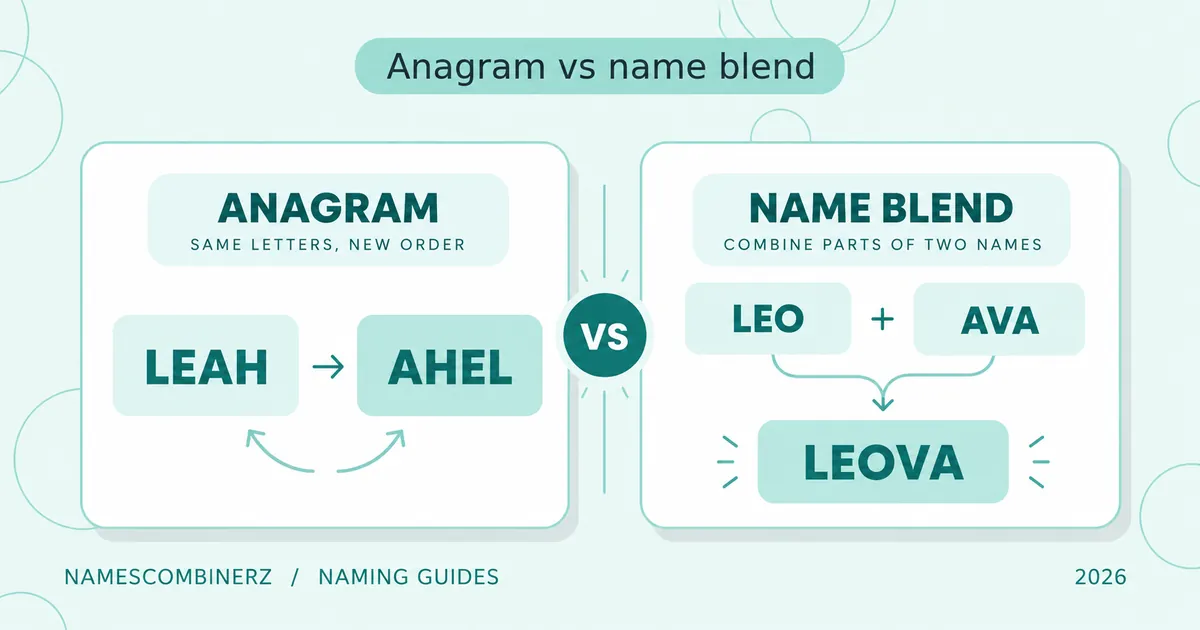
Two tools can produce a completely different name from the same input, yet work by different rules. The name blender rearranges chunks of words and may drop or repeat letters. An anagram rearranges existing letters; a strict anagram preserves the letter count exactly. Knowing the distinction helps you pick the right generator for a puzzle, shared handle or creative project.
What a name blend does
A blend joins recognizable parts of two source names. It might take the beginning of one word and the ending of another, overlap shared sounds or swap the input order. “Mara” and “Leo” could inspire “Marleo” or “Maleo.” Those spellings are examples of blends, not dictionary words. Their letter totals do not have to match the originals.
What an anagram does
A full anagram takes every letter from the input and places those same letters in a different order. “LISTEN” can become “SILENT” because the two words contain the same letters with the same frequencies. For names, many valid permutations will not form recognizable or pronounceable words. That does not make them invalid as permutations, but it matters if you want a usable name.
Compare the same input
| Method | Source | Example result | Rule |
|---|---|---|---|
| Blend | Mara + Leo | Marleo | Mix portions; letters may change |
| Concatenation | Mara + Leo | MaraLeo | Keep both original strings |
| Anagram | LISTEN | SILENT | Use exactly the same letters |
Which tool should you choose?
Choose the Name Combiner if you want a name where you can still hear or see the original inputs. That is useful for couple nicknames, baby-name inspiration or projects based on two founders. Choose the Anagram Generator if using the source letters exactly is important—for example, a word game, team puzzle, escape room or fictional clue.
Why some anagrams are hard to pronounce
Letter rearrangement does not imply a natural spoken rhythm. The same letters can be arranged into long consonant groups or uncommon vowel positions. A result can satisfy the letter rule yet be unsuitable as a brand or real first name. When evaluating anagrams for naming, filter them by readability after you generate them, not just by formal correctness.
What about partial anagrams?
Some wordplay uses only a subset of the original letters. That is not a strict full anagram, even though it may be useful in creative naming. If your purpose is a fair puzzle, be explicit about whether all letters must be used. Our Anagram Generator uses all the provided letters in its permutations; it does not claim that each result is a real word.
Pick results that work in context
For a puzzle, check that the rearrangement is solvable. For a team or brand name, favor easy pronunciation and simple spelling. For a person’s name, consider cultural appropriateness and established meanings. In every case, the tool generates candidates but leaves the real-world decision to you.
Try a two-step creative exercise
- Enter two short words in the Anagram Generator and save your most readable permutations.
- Enter those same words in the Name Combiner and compare the blends.
- Write down which results preserve recognizable origins, which feel natural aloud, and which would work for the intended audience.
You will often find that a blend works better as a public name while an anagram works better as a puzzle or Easter egg. Neither is automatically better; the task determines what “useful” means.
A practical deep dive with real-world checks
Use the following steps in order if you are starting from scratch, or jump to the part that addresses your biggest obstacle. The goal is to produce a small number of ideas that are understandable, appropriate and easy to test. For public or commercial naming, distinguish a creative shortlist from checked availability and formal rights.
1. Learn what an anagram actually preserves
A strict anagram uses the same letters with the same counts after normalizing conventions such as spaces or punctuation. It does not add unrelated letters just to create a smooth name. This constraint makes anagrams suitable for puzzles but often limits natural-sounding name ideas.
The underlying decision is about human recognition, not the largest number of generated variations. Work from a blank sheet rather than from a hundred automatic suggestions. Put your first three possibilities on separate lines and annotate which part of the idea comes from which source.
Listen and silent are a well-known English anagram pair. Their letter counts match even though the order changes.
Try it yourself: Sort the letters of each candidate alphabetically and compare the two inventories. Use the observation to decide whether to keep, revise or discard the candidate.
2. Understand what a blend preserves
A blend usually preserves meaningful or recognizable fragments rather than the entire inventory of source letters. Its purpose is often rhythm and association, not exact rearrangement.
A practical comparison helps distinguish your own familiarity from how the idea appears to a first-time reader. Try a blind read. Ask one person who has not seen your original inputs to describe what they notice first, then show them the construction.
Brunch blends parts of breakfast and lunch; it is not a rearrangement of every letter in those two words.
Try it yourself: Underline the portion inherited from each source and see whether a listener can hear it. Use the observation to decide whether to keep, revise or discard the candidate.
3. Decide whether your goal is a puzzle
If the challenge requires using every letter, choose an anagram. If you want an easy-to-say joint nickname, choose a blend. Applying the wrong success criterion makes useful results look like failures.
This is where a short written test can prevent enthusiastic but inconsistent choices. Make the comparison reproducible by recording the exact version you tested and the reason it made your shortlist. For instance, if you change a vowel, keep both spellings long enough to compare them aloud.
A word-game challenge may reject a perfectly pleasant blended nickname because its letters do not match the input inventory.
Try it yourself: Write the rule before generating candidates: exact letters or recognizable sounds. Use the observation to decide whether to keep, revise or discard the candidate.
4. Normalize punctuation carefully
Anagram tools may ignore spaces, capitalization and punctuation, but must not silently change spelling without telling the user. For names with accented letters or non-Latin scripts, normalization should be described clearly.
Consider the environment in which someone will encounter the result without your explanation. Test the idea at realistic size and speed. A nickname in a text message, a business name on a receipt and a child's name spoken in a classroom place different demands on the same letters.
A puzzle that treats accented characters as distinct can have a different result from one that folds them into plain Latin letters.
Try it yourself: Agree on the alphabet and accent rules before testing whether two phrases match. Use the observation to decide whether to keep, revise or discard the candidate.
5. Use blends when pronunciation matters
A smooth blend can omit letters and reuse a sound at the seam. That flexibility can create shorter, more memorable labels, though it means the result is not an anagram of the source text.
Instead of asking for approval, look for an observable point of confusion or advantage. Look for disconfirming evidence, not just compliments. A shortlist becomes more trustworthy when you invite someone to identify confusing spelling, unintended resemblance or unfamiliar pronunciation.
A couple name can use two identifiable syllables even when one person contributes only a few letters.
Try it yourself: Read the blend aloud and inspect the phonetic join instead of counting characters. Use the observation to decide whether to keep, revise or discard the candidate.
6. Avoid assuming a word is new
Both anagrams and blends can accidentally reproduce established words, surnames or business names. Creative transformation is not clearance, and dictionary overlap can matter for commercial purposes.
A sensible limit on brainstorming creates room to evaluate what you have already collected. Set the task a clear stopping point. Creative search can become endless because every candidate invites another variation.
A clever anagram that spells a familiar term is still that familiar term; a blended brand may overlap with existing services.
Try it yourself: Search exact and similar spellings before public or commercial use. Use the observation to decide whether to keep, revise or discard the candidate.
7. Evaluate output with the correct standard
For anagrams, validate that every letter is accounted for. For blends, score sound, recognition, appropriateness and context. Do not compare the number of permutations with the number of pleasing spoken results as if both were measures of quality.
Some checks require information outside the generator and deserve their own place in the process. Keep an honest record of uncertainty. Some questions, particularly language meanings, trademark conflicts and account availability, cannot be settled by a blending algorithm.
An algorithm can create thousands of technically valid letter orders that are not usable words or names.
Try it yourself: Define two separate columns: technical validity and human usefulness. Use the observation to decide whether to keep, revise or discard the candidate.
8. Try a combined brainstorming exercise
Start with a short pair of words. Generate a few blends to discover promising sound patterns, then experiment with anagrams of a selected short word if your project supports playful clues. Keep the transformations labeled so readers are not misled.
The final goal is a usable idea, not proof that your creative method can always produce one. Finish by comparing a simple alternative. A creative transformation earns its place only when it works better for your purpose than leaving the words unchanged or choosing a familiar label.
A children’s puzzle might use anagrams as clues and a blended final team name as a reward, clearly separating the two mechanics.
Try it yourself: Explain to another person how the chosen final name was built and what rule it follows. Use the observation to decide whether to keep, revise or discard the candidate.
A reusable worksheet for your next naming session
Copy the prompts below into a note before generating a new batch. A written record is especially useful when you are comparing choices with another person or revisiting the idea after a few days. It turns an exciting but subjective naming session into a process you can review.
- Learn what an anagram actually preserves: Sort the letters of each candidate alphabetically and compare the two inventories. Record one candidate, one observation and one change you would consider. Do not award a high score merely because the idea is new. The important point is whether the observation helps with anagram versus name blending methods in your actual setting.
- Understand what a blend preserves: Underline the portion inherited from each source and see whether a listener can hear it. Record one candidate, one observation and one change you would consider. Do not award a high score merely because the idea is new. The important point is whether the observation helps with anagram versus name blending methods in your actual setting.
- Decide whether your goal is a puzzle: Write the rule before generating candidates: exact letters or recognizable sounds. Record one candidate, one observation and one change you would consider. Do not award a high score merely because the idea is new. The important point is whether the observation helps with anagram versus name blending methods in your actual setting.
- Normalize punctuation carefully: Agree on the alphabet and accent rules before testing whether two phrases match. Record one candidate, one observation and one change you would consider. Do not award a high score merely because the idea is new. The important point is whether the observation helps with anagram versus name blending methods in your actual setting.
- Use blends when pronunciation matters: Read the blend aloud and inspect the phonetic join instead of counting characters. Record one candidate, one observation and one change you would consider. Do not award a high score merely because the idea is new. The important point is whether the observation helps with anagram versus name blending methods in your actual setting.
- Avoid assuming a word is new: Search exact and similar spellings before public or commercial use. Record one candidate, one observation and one change you would consider. Do not award a high score merely because the idea is new. The important point is whether the observation helps with anagram versus name blending methods in your actual setting.
- Evaluate output with the correct standard: Define two separate columns: technical validity and human usefulness. Record one candidate, one observation and one change you would consider. Do not award a high score merely because the idea is new. The important point is whether the observation helps with anagram versus name blending methods in your actual setting.
- Try a combined brainstorming exercise: Explain to another person how the chosen final name was built and what rule it follows. Record one candidate, one observation and one change you would consider. Do not award a high score merely because the idea is new. The important point is whether the observation helps with anagram versus name blending methods in your actual setting.
Once you have filled in the worksheet, compare the first draft with the version you would really be comfortable using. If the strongest candidate survives the tests, save it alongside the reason for choosing it. If the choice still feels uncertain, a small amount of focused testing is more useful than starting an enormous new list.
Frequently asked questions
Is an anagram the same as a nickname generator?
No. A nickname generator may shorten names or add descriptive words; an anagram must satisfy a letter-rearrangement constraint.
Can anagrams use extra letters?
A strict anagram should not. Some loose wordplay games use other rules, which should be stated explicitly.
Is a portmanteau a name blend?
Portmanteau is a type of blend that combines recognizable parts of words. Not every name combination is a portmanteau.
Which tool is better for couples?
A name combiner generally fits a shared nickname better, while an anagram tool can be fun for puzzles or secret clues.
What is the fastest way to test this idea?
For anagram versus name blending methods, start with learn what an anagram actually preserves. Make a shortlist of three rather than a huge collection, then perform the specific test from the relevant section. Try it in a real sentence, a practical mockup or a neutral conversation. A small test tied to the intended audience is more revealing than a quick popularity poll.
How do I know whether a suggestion is actually useful?
For anagram versus name blending methods, start with understand what a blend preserves. A useful candidate should work for the stated purpose and survive the practical check that matters most: clarity, pronunciation, cultural fit or potential conflict. Write one reason it succeeds and one uncertainty to resolve. The result should still make sense after the exciting first impression fades.
Next steps: turn this research into a shortlist
Open our Anagram Generator to explore concrete variations. Generate broadly, save selectively and revisit the strongest choices after testing. For a different approach, compare the related Name Combiner and Couple Name Combiner tools. These links are exercises, not claims that every output is available or suitable.
Editorial note: This guide provides creative methods and practical checks; it does not certify origin, meaning, legal rights, platform availability or suitability for every culture. Review the results independently before making a permanent decision.
Try these ideas yourself
Use our generator, compare a shortlist and save your favorite results in your browser.